

Third Quarter 2026 Market Update
Our Second Half View
We see the second half of the year resembling the first half in several important respects: a fundamentally constructive economy, continued corporate earnings growth, higher equity prices—and at least one uncomfortable drawdown along the way before ultimately recovering into year-end. Or, in the famous words of the great Yogi Berra, the second half of the year just might be deja vu all over again.
We have a heavily conditional outlook for fixed income entering the second half. On the one hand, bonds still carry enough starting yield to contribute meaningful income even without substantial price appreciation.
On the other hand, the direction of returns, among other things, will depend heavily on the Federal Reserve. If monetary policy remains steady—or turns dovish—high-quality bonds could benefit from both income and price appreciation. If the Fed becomes more hawkish and raises rates, shorter maturities should prove more resilient, while longer-duration bonds would likely face renewed price pressure.
A Constructive Foundation
The stock market’s advance has not been based on optimism alone. Corporate fundamentals have continued to validate the move higher and this matters because durable bull markets ultimately require earnings.
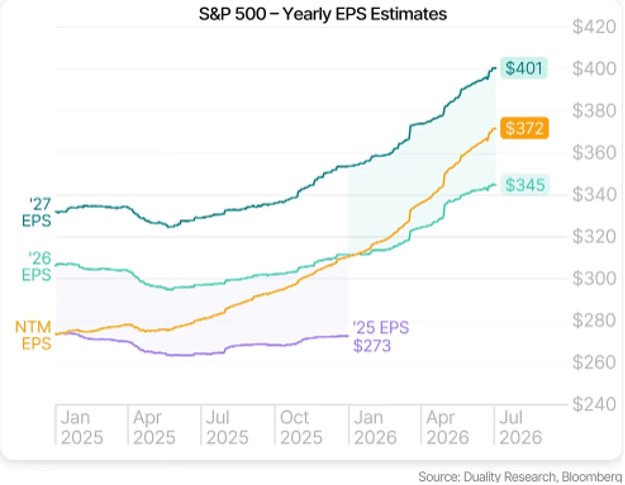
Earnings estimates have moved higher since the beginning of the year, and current expectations point toward another year of strong profit growth for 2026. Analysts are currently forecasting further gains for 2027 with S&P 500 earnings per share (EPS) consensus of around $400.
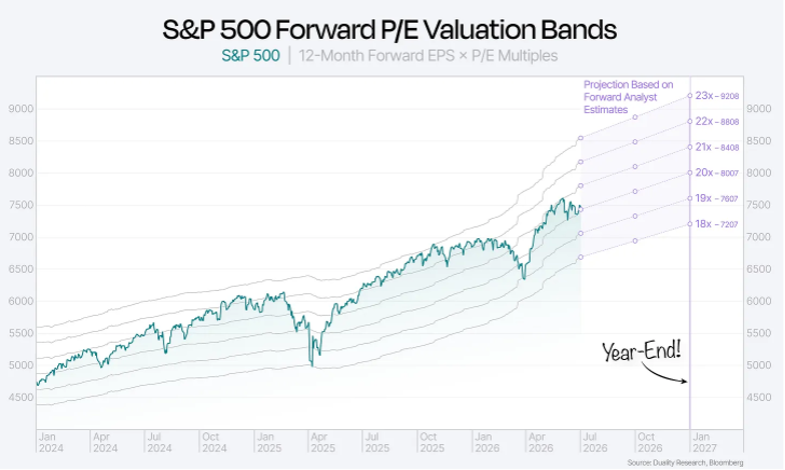
Below are two charts from Duality Research. The first chart shows consensus S&P 500 yearly earnings estimates. Notice the strong direction as much as the number. The second chart puts EPS next to forward price-to-earnings multiples to produce a range of valuation bands.
You may be thinking, ok, the math squares but only if actual earnings materialize as estimated. Below is a chart from Matt Cerminaro showing the historical relationship between S&P 500 actual earnings and Wall Street estimates made 12 months earlier. The dark blue line is the actual EPS over the past year. The light blue line is the estimated EPS over the next year, pushed forward 12 months, so the estimates and actuals cover the same period.
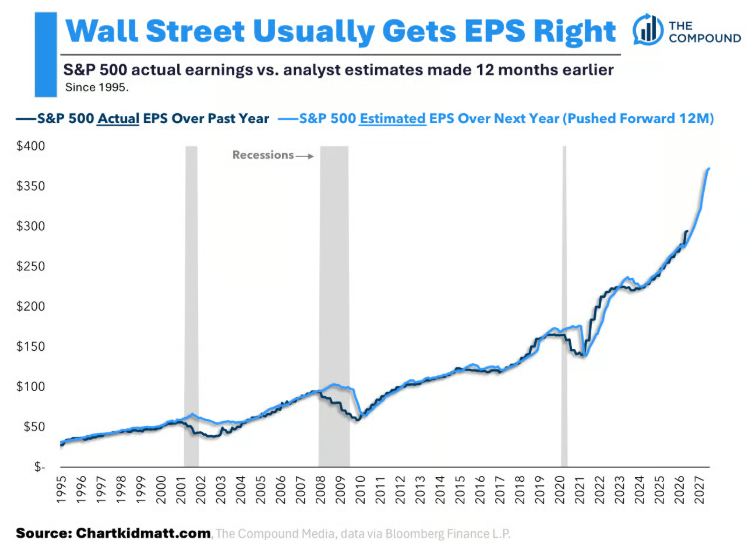
What stands out is how accurate analyst earnings estimates are for the S&P 500, with recessions being the exception. To put a number on it, Cerminaro further shows the median spread between actual and estimated earnings is just 1.5% outside of recessions. Quite impressive, really.
The main takeaway for us is not a precise year-end target, but that roughly $400 of S&P 500 earnings in 2027 appears achievable if current profit trends continue. Under that scenario, today’s valuation can remain defensible, and the path of least resistance still appears higher.
However, that does not guarantee the path will be smooth.
Let’s Talk About a Correction Before the Next One Happens
Bull markets do not travel unopposed, in a straight line up and to the right. They move ahead, become extended, encounter a new concern, reprice risk and then reassess whether the original investment landscape remains intact.
The first half of 2026 offered a useful example. Geopolitical conflict created a sharp narrative change, disrupted markets and raised fears of escalating war and commodity price shocks. Fear changed prices more quickly than it changed fundamentals and therefore, markets recovered.
We expect the second half could contain another episode that feels similar in structure. The catalyst could once again be geopolitical. It could involve inflation, energy prices, fiscal policy, credit markets, artificial-intelligence spending, the Fed, an unexpected economic slowdown or something that is not presently on anyone’s list.
In our opinion, investors should remain positioned to participate in this market. That is not complacency; it is an acknowledgment that the goal is not to predict future selloffs or react to every shift in sentiment, but to maintain perspective when volatility arrives and distinguish between price disruption and fundamental deterioration. As long as the latter does not follow the former, any weakness could ultimately prove temporary.
All told, we expect the second half to reward both participation and perspective: participation while a constructive economy and rising corporate earnings support further gains and perspective when the next bout of volatility inevitably tests that outlook.
To our clients, thank you for the opportunity to serve your investment needs and please do not hesitate to contact us if you experience any material changes in your personal situation or would like to discuss any specific matters.
Please keep an eye out for our regular in-person seminars and online webinars, where we discuss specific topics in a more in-depth setting. Stay tuned to our emails and follow us on social media for event announcements and details.
Disclosures
Ables, Iannone, Moore & Associates, Inc. (“AIMA”) is an independent, fee-only registered investment adviser with the U.S. Securities and Exchange Commission (“SEC”). Registration as an investment adviser does not imply a certain level of skill or training. The information contained herein is provided for educational and informational purposes only and should not be construed as personalized investment advice.
Opinions expressed are subject to change without notice and are not intended as a forecast, guarantee, or assurance of future results. All investing involves risk, including the potential loss of principal. Past performance is not indicative of future results.
For additional information about AIMA’s advisory services, please see our Form ADV, which is available upon request or at www.adviserinfo.sec.gov.