

Fourth Quarter 2026 Market Update
Yet, this investment boom is occurring alongside a sharp increase in long-term borrowing costs and a concentration of market performance in relatively few companies. The result is an unusual investment environment: substantial economic opportunity accompanied by near-term dependence on the continued success of a single capital investment cycle that ultimately must bear fruit and produce increased corporate revenue and earnings.
The Narrow Path
The S&P 500 has gotten “cheaper” over the course of the year. Using data from FactSet, the forward 12-month Price-to-Earnings ratio has compressed from roughly 22x down to 19x. The multiple contraction occurred entirely because earnings-per-share (EPS) growth accelerated.
However, this is a bit of an illusion, as Michael Cembalest of J.P. Morgan illustrated in a recent note about how narrow the path has been for the S&P 500. His findings show, since January 2024, a basket of just 42 AI-related companies have accounted for approximately 67% of S&P 500 price returns, 58% of earnings growth, and 81% of capex and R&D growth.
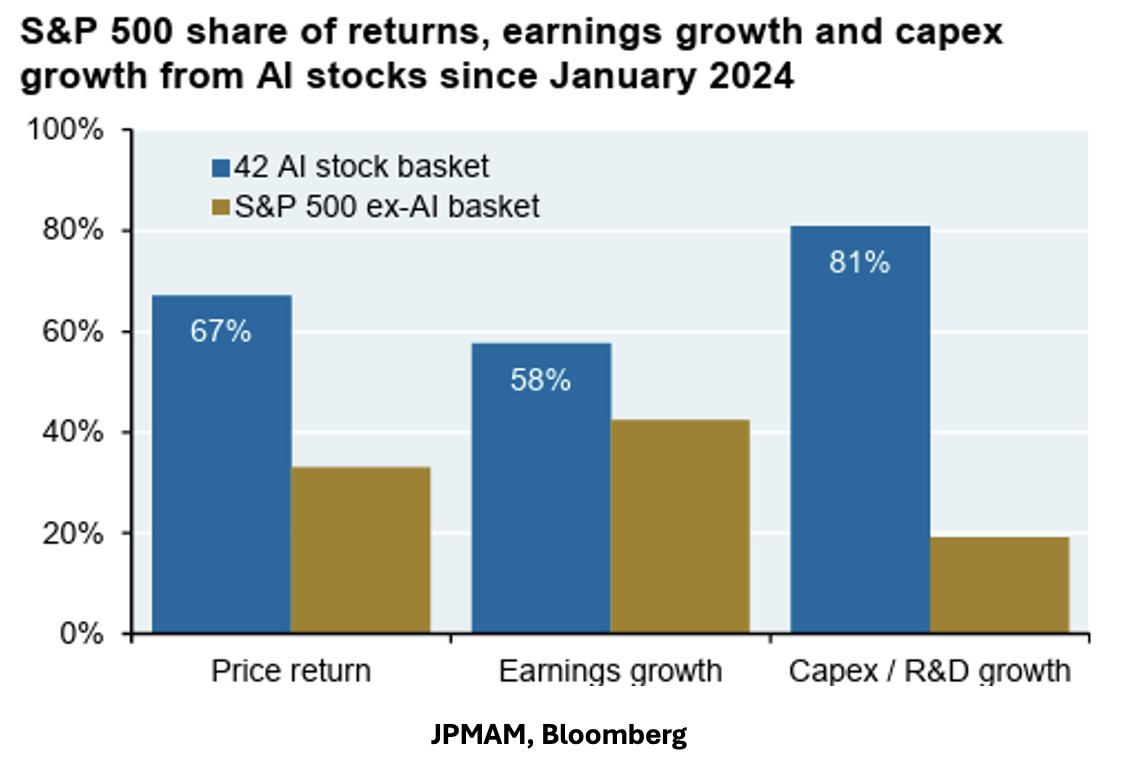
Cembalest goes on to highlight the divergence between the index and its underlying companies. The S&P 500 index is sitting near its all-time high while approximately 60% of S&P 500 stocks have fallen 20% or more below their individual all-time highs.
Looking over the preceding three years, only 30% of companies have outperformed the S&P 500 index, one of the lowest readings in more than three decades.
Nonetheless, concentration alone does not prove much without context. To this point, much of the appreciation in AI adjacent stocks has been supported by genuine earnings growth rather than investors simply paying higher multiples. The companies supplying semiconductors, computing capacity, networking infrastructure, power and electricity are benefiting from tangible demand. We would expect investors to flock to this corner of the market, and they have.
The Bond Market: Repricing
One of the more significant developments of 2026 has been the sharp increase in longer-term government bond yields.
The benchmark 10-year U.S. Treasury yield has moved above 5.0%, while the 30-year yield has approached 5.6%. Because bond prices move inversely to yields, these increases have produced difficult returns for investors holding longer-duration fixed income securities.
Inflation levels and changes in Federal Reserve policy provide part of the explanation. But there are several supply and demand factors in play as well. On the supply side sits large fiscal deficits, government borrowing needs and competition from massive investment-grade corporate debt issuance. On the demand side are changes in the composition of bond buyers (think institutions and hedge funds) and reduced central bank support. What’s left is a structural repricing of duration risk and the compensation required to supply long-term capital.
And it’s not just a U.S. issue; global bond yields have risen across numerous developed economies with varying growth rates, inflation levels, fiscal, and monetary policies.
Returning to the U.S Treasury story, yields influence borrowing costs throughout the economy, including mortgages, corporate financing, commercial real estate, and the discount rates used to value financial assets.
The same capital expenditures supporting economic growth require businesses and investors to generate sufficient future returns to justify their cost. As financing becomes more expensive, the hurdle for profitable investment rises.
That said, higher interest rates do not automatically wreck a healthy economy or a rising stock market. We continue to view fixed income as an essential component of diversified portfolios, with greater attention warranted toward maturity structure, interest-rate sensitivity, and credit quality.
Looking Ahead
Two things can be true at the same time. A transformative technology like artificial intelligence can generate enormous economic value while producing very different financial outcomes for the companies developing, financing, and adopting it.
Markets are not obligated to distribute returns evenly. They assign value today to expectations of tomorrow. Currently, those expectations are concentrated in a relatively narrow group of AI-related companies, while rising long-term interest rates are creating a more demanding environment for financing future economic growth.
Our outlook remains constructive, but the opportunities ahead may look different from those that have driven returns in recent years. We believe it’s important to maintain exposure to the companies leading today’s economic transformation while recognizing the potential for earnings growth and market participation to broaden. Meanwhile, higher interest rates have restored meaningful income opportunities in fixed income. Rather than positioning portfolios around a single market outcome, our focus remains on capturing these opportunities while maintaining the flexibility to adapt as expectations and economic realities evolve.
To our clients, thank you for the opportunity to serve your investment needs and please do not hesitate to contact us if you experience any material changes in your personal situation or would like to discuss any specific matters.
Please keep an eye out for our regular in-person seminars and online webinars, where we discuss specific topics in a more in-depth setting. Stay tuned to our emails and follow us on social media for event announcements and details.
Disclosures
Ables, Iannone, Moore & Associates, Inc. (“AIMA”) is an independent, fee-only registered investment adviser with the U.S. Securities and Exchange Commission (“SEC”). Registration as an investment adviser does not imply a certain level of skill or training. The information contained herein is provided for educational and informational purposes only and should not be construed as personalized investment advice.
Opinions expressed are subject to change without notice and are not intended as a forecast, guarantee, or assurance of future results. All investing involves risk, including the potential loss of principal. Past performance is not indicative of future results.
For additional information about AIMA’s advisory services, please see our Form ADV, which is available upon request or at www.adviserinfo.sec.gov.