

Market Update – First Quarter, 2026
THE “WALL OF WORRY” refers to the steady drumbeat of risks that dominate headlines and investor conversations during most market cycles. These concerns rarely disappear all at once. Instead, markets advance as investors gradually gain confidence that the economy can absorb them. Climbing the wall of worry does not mean ignoring risk; it means staying disciplined, diversified, and invested while markets work through uncertainty over time.
As we enter 2026, we remain positive on markets based on supportive conditions. Periods of volatility should be expected, and pullbacks or a correction would not be unusual. That said, we would be surprised if equity markets did not end the year higher than where they began.
Fixed income markets present a different, but complementary, opportunity set. We expect modest, income-driven total returns in what appears to be a largely range-bound interest rate environment.
What Would Change Our View
Our favorable outlook, however, is conditional. Below we highlight several key bricks in the wall of worry that would warrant reassessment of market conditions if they happened to materialize.
Broad earnings expectations reset lower
Current valuations assume resilient margins and earnings growth. Analysts estimate ~15% earnings per share (EPS) growth for the S&P 500 this year. A broad downward revision cycle – driven by margin compression, falling demand, or cost shocks – would reduce the market’s ability to absorb volatility without repricing lower.
Labor market deterioration
The labor market is in a “no-hire, no-fire” stalemate largely supported by the gig economy which acts as a shock absorber and buffer beyond traditional unemployment support systems. If persistent weakness turns into layoffs, pressuring consumption and earnings durability, the market story would change.
AI investment shifts from productivity to speculation
Our constructive view on AI is rooted in productivity and long-term capital formation that will generate economic growth. That view would change if capital deployment became leverage-driven or the AI capex story becomes disconnected from defensible assumptions of future economic return.
OpenAI goes public and sells off
OpenAI (think ChatGPT) is a private company and one of the main characters in the current AI story. Because it is not publicly traded it does not face the same level of valuation scrutiny and price discovery that public markets provide. OpenAI has projected revenues of $10–$12 billion against spending commitments approaching $1.4 trillion. If they decided to go public this year the market’s reception or rejection of that offering would be a closely watched signal for the entire AI story.
Credit stress intensifies
Equity markets rarely suffer extreme drawdowns without credit events. There are large, less transparent pockets of risk such as private credit, but credit spreads remain tight, and financing conditions appear orderly which suggests stress is being absorbed gradually. A disorderly widening of credit spreads, rising default rates across multiple sectors, or funding market stress would indicate forced deleveraging rather than isolated balance-sheet issues.
The Federal Reserve surprises
Markets are currently aligned with a patient, data-dependent Fed. Forecasts suggest the Fed will hold rates steady through the first half of 2026 with the second half of the year possibly seeing one or two more cuts. Any shift in policy stance outside of market expectations introduces volatility. (Hawkish = inflation is likely problematic. Dovish = weakness in growth and/or labor markets.)
Geopolitical event contagion
Multiple global theaters remain capable of producing sudden risk-off episodes. Markets typically understand and discount this chronic risk. They struggle with acute events that disrupt commodity markets, trade flows, or global liquidity.
Shifting trade war and tariff regime
The issue now sits with the U.S. Supreme Court. Outcomes range from no modification to partial modification to full repeal with reimbursement – each carrying implications for both equity and bond markets.
Inflation re-accelerates
A sustained rebound in inflation beyond seasonal effects would challenge the current policy path. If inflation pressures forced the Federal Reserve back into a renewed tightening cycle, a policy-induced slowdown would rise materially.
U.S. equity valuations soar on the wings of multiple expansion
Earnings growth – not multiple expansion – was the primary driver of S&P 500 returns in 2025. Much of the bubble and expensive market talk has focused on valuation metrics in isolation. Doing so blurs the picture. You are looking at a scatterplot of forward price-to-earnings and forward net margins. The greater the margin expansion the higher the multiple investors are willing to pay. Currently, we sit just north of the trendline over the last 12 years. If investor euphoria pushes the markets higher, paying more and more for the same or softening margin and earnings backdrop, our view would change.
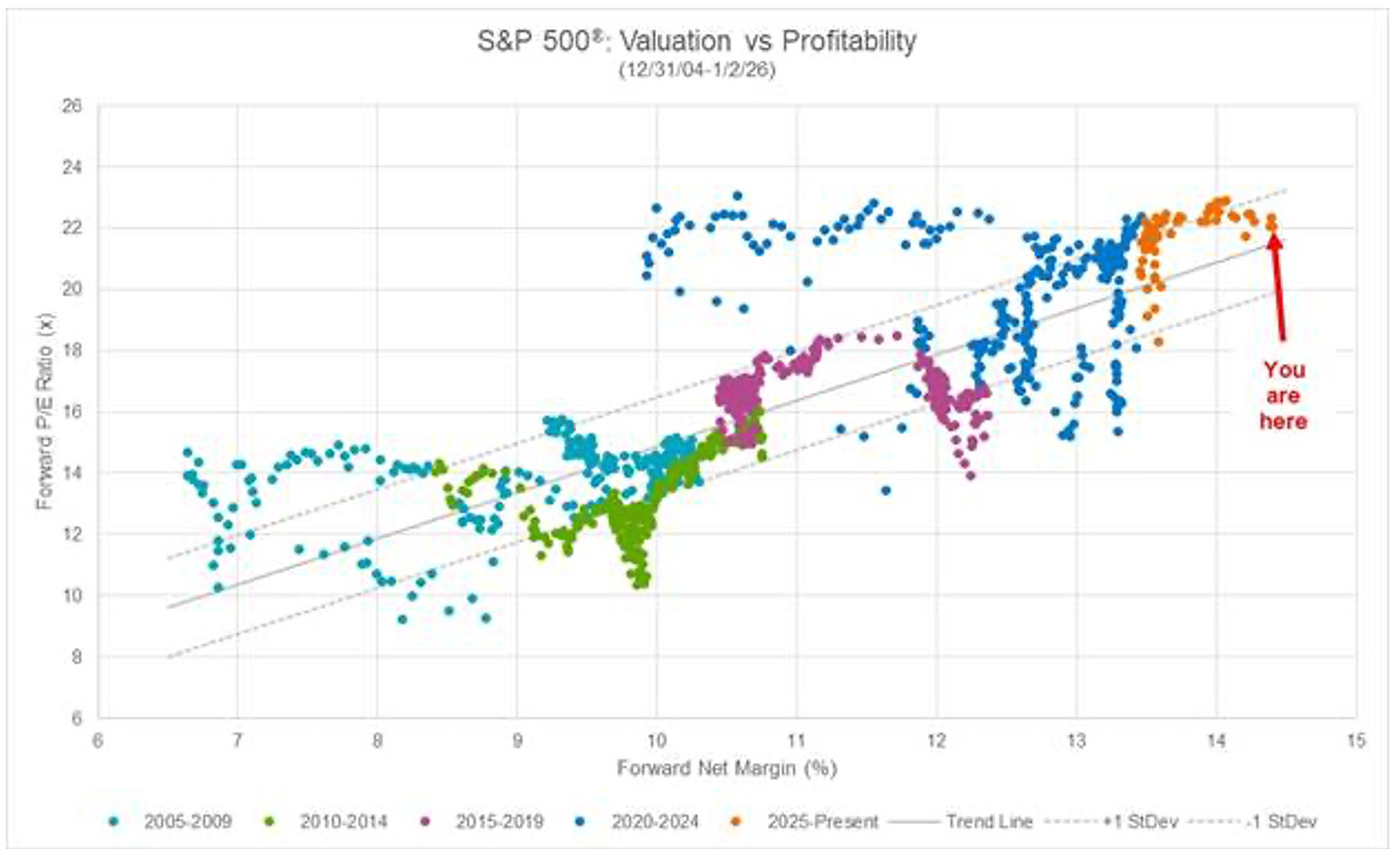
Source: Natixis, FactSet
In Closing
We’re positive about the new year. We do expect volatility, periodic pullbacks or even a correction as markets reconcile the ebbs and flows of uncertainty. But as history suggests, long-term returns are earned not in the absence of uncertainty, but in its presence.
To our clients, thank you for the opportunity to serve your investment needs and please do not hesitate to contact us if you experience any material changes in your personal situation or would like to discuss any specific matters.
To our other readers, if you would like a complimentary review of your investment accounts or any other financial planning matters, please do not hesitate to contact us. As fiduciaries, we will happily provide you with an unbiased opinion based on your specific situation.